

Marshall set to demolish former headquarters tomorrow, ‘site of so much history’
By Rick Smith
Even as NASA and its partners nationwide prepare for the launch of Artemis I, opening a bold new chapter in human space exploration, workers at NASA’s Marshall Space Flight Center in Huntsville, Alabama – which led development and ground testing of the new Space Launch System rocket – are gearing up for a second big countdown.
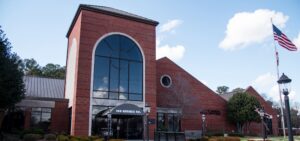
When the clock ticks down to zero this time, however, it will mark the October 29 implosion of Building 4200, Marshall’s administrative headquarters for 63 years. That event will close a big chapter of the pivotal NASA center’s history, clearing the way for new missions that will take us deep into the century ahead – and even deeper into the cosmos.
“This is the site of so much history for NASA,” said Marshall Director Jody Singer, its 14th leader since it was founded. “But as responsible stewards of taxpayer dollars, it’s our duty never to linger over yesterday’s successes. Time marches forward, and our space mission awaits. While buildings are part of our history, it’s people who have made us what we are and who will lead us into the future. We’re excited to look ahead to the facilities and resources we need to chart the next 60 years and beyond.”
For more than six decades, NASA and the nation have relied on Marshall to deliver its most vital propulsion systems and hardware, flagship launch vehicles, world-class space systems, state-of-the-art engineering technologies and cutting-edge science and research payloads – work overseen by Marshall leaders and managers in Building 4200.
That includes development of the Saturn V rocket that lofted the Apollo missions to the Moon; engines and propulsion hardware for the Space Shuttle Program; hardware, air and water recycling systems, and science communications for the International Space Station; delivery of the Chandra X-ray Observatory and elements of the James Webb Space Telescope; and management of the Space Launch System, the Human Landing System Program, and other elements of NASA’s Artemis-era return to the Moon. MSFC also developed and delivered the Hubble Space Telescope.
Scott Worley, Marshall’s historical preservation officer, said the real key to NASA’s successful pursuit of its mission over the past six decades isn’t in a building, but in “the generations of visionary innovators who walk its halls.”
“Buildings come down,” Worley said, “but rockets keep going up. Our work lies beyond the sky.”
Even so, the legacy of Building 4200 lingers in the minds of its former occupants and NASA retirees. Brian Odom, acting NASA chief historian, credits that to the galvanic shift Marshall helped lead over the years.
“It’s not a laboratory or a test site, it didn’t house critical rocket hardware or science payloads,” Odom said. “Its impact is really about the decisions made there, the critical choices enacted across the whole history of American spaceflight. The calls made by those teams still drive us onward, and still color our perception of the best we can be and the finest work we can do.”
Following formal establishment of Marshall in July 1960, Marshall leaders selected architectural firm Wyatt C. Hendrick of Fort Worth, Texas, to design the center’s first administrative hub. Electronic and Missile Facilities Inc. of Valley Stream, New York, built the facility. Ground was broken on Sept. 30, 1961, and the first center employees began moving in in June 1963. Building 4200 initially was home to workers in the Aeroballistics Division, Research Projects Division, Future Projects, and the Launch Operations Directorate which later would move to NASA’s Kennedy Space Center in Florida.
Modeled after the utility-meets-expediency formula adopted by U.S. military posts, Building 4200 also home for years to a library, mail office, barber shop, cafeteria, photo lab, and other services. Guests who came to meet with Marshall leaders – and often to address team members in spacious Morris Auditorium – routinely included astronauts and spaceflight authorities, White House representatives and congressional leaders, and state executives from all over the world.
Others toured Marshall as well, from former First Lady Claudia “Lady Bird” Johnson and the visionary German film director Fritz Lang to Gen. Chuck Yeager, who in 1947 became the first jet pilot to break the sound barrier – an event which helped usher in the space age. Novelist Ben Bova, acclaimed author of more than 120 works of science fact and science fiction, shook hands with Marshall workers here in 2000; members of the world-renowned rock band Styx did the same 18 years later.
But demolishing the aging structure, which would be prohibitively expensive to renovate, opens a path to the future for Marshall and its workforce, said John Green, Marshall’s master facilities planner in the Office of Center Operations.
“The key to success is to evolve and grow to meet the needs of new generations of innovators and engineers,” Green said. “It’s our job to prepare Marshall to tackle new agency directives and to succeed in a changing work environment. We will continue to build facilities as flexible and adaptable as the teams housed in them.”
And those teams will confidently continue to lead NASA and the nation into a rewarding and productive spacefaring future.
Read more about the history of Building 4200 at:
https://www.nasa.gov/centers/marshall/history/building4200.html